Polish Easter
Polish Easter Wielkanoc
Oh how much I love this time of year. Start of spring, painting eggs, delicious food and seeing Declan being grumpy as he has to carry a delicately decorated Easter basket to church. That’s Easter for me. However there is a lot more to this special holiday. How does a Polish Easter holiday take shape? Read here to see what takes place during our Polish Easter holidays.
Polish Easter “Wielkanoc” Painting and Prayers
It all starts a week before Easter, Palm Sunday (Niedziela Palmowa) with colourful “palmy” being sold at stalls or shops. The churches and houses are then decorated with these “palms” and pussy willow (haha pussy willow).
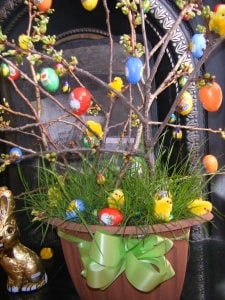
I remember me and my siblings collecting “bazie” every year from the lake near our house in Poland. The whole week before Easter Sunday involves massive spring cleaning of your home. Once Saturday comes this is where the fun starts as we paint eggs, just like being back in junior school all over again. These eggs are called “pisanki”. There are various types of “pisanki”, based on the technique and preparation used: Here I will use a little help from Google to describe the types of Pisanki, or eggs, as if I was to explain my way we’d be all confused. Pisanki are an important part of Polish Easter tradition and I simply love decorating them.
Pacenka are created by drawing or painting. Traditional technique requires the egg-shell to be covered with a layer of molten wax in which the pattern is scratched.
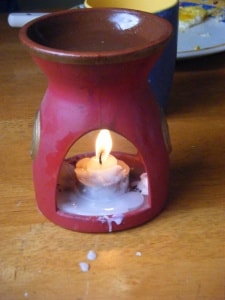
The egg is then submerged into a dye. Finally, the wax, preventing the dye to adhere to the eggshell is removed.
Naklejanki or nalepianki are decorated with petals of elderberry, scraps of colourful paper (including wycinanki) or with patches of cloth. Popular in Łowicz and the surrounding area.
Oklejanki or wyklejanki are decorated with bulrush pith or yarn. They are common in the Podlaskie region of Poland.
Kraszanki are made by boiling an egg in a decoction of plants or other natural products. The colour of kraszanka depends on the kind of product used:
- brown: onion peels;
- black: oak or alder bark or the nutshell of walnut;
- golden: the bark of young apple tree or the marigold flower;
- violet: petals of the mallow flower;
- green: shoots of young rye or leaves of periwinkle;
- pink: the juice of beet.
Drapanki are made by scratching the surface of a kraszanka with a sharp tool to reveal the white of the egg-shell.
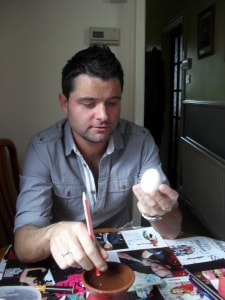
I bet you never thought eggs could be so complicated! The way my family creates their “pisanki” are the “Pacenka” way. Here the family gathers around the table to paint their blank boiled white eggs using hot melted wax. We use the same tools each year to apply the hot wax. A pencil with headed pin attached at the top which is dipped into the hot wax and applied to the egg.
Together with Declan we make a “pisanke” for each other. First year started off with love hearts, love words etc and now we write something funny or stupid or just draw each other.
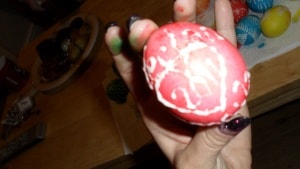
Ahh the romance of marriage!! Declan also has a tradition to bring some Irish to the table and paints an Irish “pisanke”. Again it could be the Irish harp, shamrock or Irish words etc. I must say we all admire his passion as it could take him quite a long time before he completes his Irish masterpiece. It’s his way of putting an Irish stamp on a Polish tradition. Once all eggs are designed you then choose your dye.
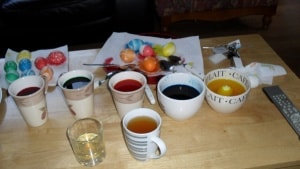
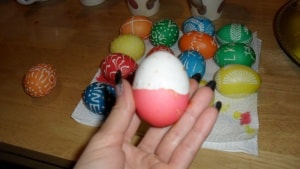
Once chosen you carefully place your eggs into cups containing the coloured dye (powder mixed with water) and wait for the transformation. After a few minutes you take them out and voila your “pisanki” are ready. It is then time to place them on some kitchen towel to dry as we all admire the family’s handywork and choose what is best or worst! Next it’s time for the Easter basket known as the “Święconka”, to be decorated, filled and blessed.
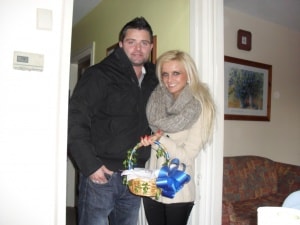
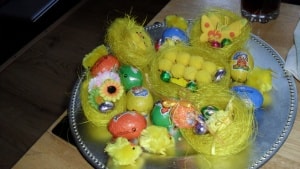
Firstly the basket will be lined with a white napkin and then all products placed on top. Products such as: piece of bread, a few decorated“pisanki”, salt & pepper, sausage and a symbolic lamb made out of butter. Here I will add that my mothers beautifully decorated “pisanki” will be the lucky ones to be displayed in the basket.
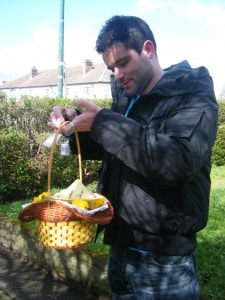
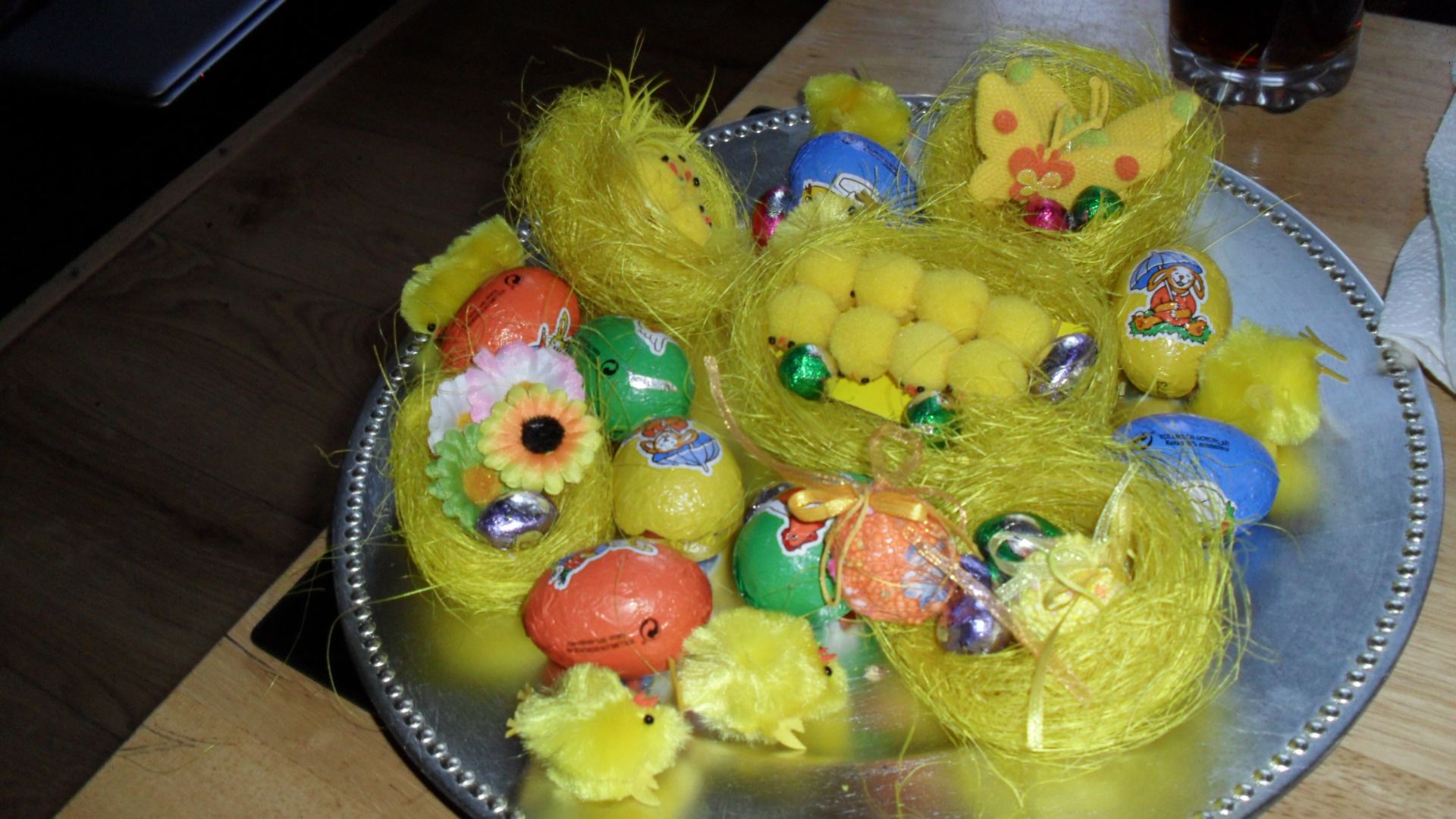
If you are really creative you can add some cute little fluffy ducks and baby chicks to the basket for effect. Let’s just say that our decorated eggs are a bit, hmmm…. ugly to be placed in the basket as once it is brought to the church it’s like a basket fashion showcase.
Once the basket is ready at home it is then brought to the local church to be blessed. Sometimes family or friends are not able to go to church themselves so you can be entering the church with more than one basket. At the church you will place your basket(s) in front of the alter or on a table and let the Priest do his job. This process is short a bit of praying, holy water splashed over the baskets and off you go. The following morning, Easter Sunday, people go to church early with families with young children adding a scavenger hunt for eggs around the home or outside.
I will admit our family does not go to church as much since living in Ireland. It’s a shame but at the same time waking up on a day off at 6am and travelling to the local Polish church is not the most pleasant thing to do. Some breakfasts with begin with sharing the “Oplatek” (holy communion wafer) which is the same as at Christmas time. Then every product that was displayed in the basket will be shared between all of us. This is where future wishes are then exchanged between all at the dinner table. It is then time to eat. Starting off with some delicious Polish traditional food which is different to Christmas with meat heavily featuring on the Easter menu.
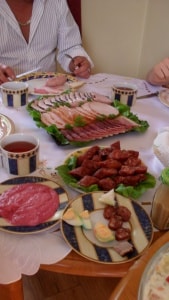
Foods such as:
- “Zurek” made out of sourdough from rye flour. Garnished with boiled white sausage and boiled egg halves.
- “Biala Kielbasa” (white sausage)
- “Sledzie” (herrings)
- “Jajka” (eggs)
- “Pasztet” (pate)
- “Szynka Pieczona” (suckling pig)
- “Chrzan” (horseradish) very important in our house.
- “Buraczki” (shredded beetroots)
- “Makowiec” a poppy seed pastry. A very traditional Polish cake
- “Babka” sponge cake.
- “Mazurek” another traditional easter cake.
This is a true meatlovers meal. This is where Declan’s “sie slini” (drools) being a meat lover, once the meal is over its time to relax and spend time with the family, chatting, playing games and simply enjoying the day and each other’s company.
The following morning begins with “Śmigus-Dyngus” also known as “Lany Poniedzialek” translated in English “Wet Monday”. Celebrated in Poland and Ukraine. Traditionally, boys throw water over girls and spank them with pussy willow branches on Easter Monday, and girls do the same to boys on Easter Tuesday. All innocent fun I can assure you despite all the spanking and water! However in Poland we all did it on Monday. It would always start with my father throwing a bucket or glass (depending on how sorry he felt for us) on us in the morning when we were asleep. Trust me it’s not the best way to wake up especially when it’s 5 or 6 in the morning. The day would continue with everyone splashing each other with buckets of water, hoses and water pistols. This also involves strangers pouring water over you from passing cars. The tradition continues by being dragged to a nearby river or pond for another drenching (usually girls).
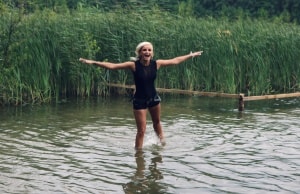
So with that damp ending comes the end of Polish Easter for another year. I must admit I love being Polish and think Poland has so much to offer with its traditions and rituals. Especially at Easter and Christmas time. I am however ashamed at times as there are so many more Polish customs I don’t follow or simply do not remember, but as I get older I realise how important it is to remember where we come from and how traditions are passed on from grandparents to parents to children.
I now appreciate all that my parents pass on to me and I started to continue, and will continue, to follow Polish traditions even if I’m married to an Irish man! Declan loves Polish Easter too even though he has to carry a girly basket to church! Aside from the meat-eating he enjoys decorating the eggs, a big kid at heart. Ireland doesn’t really have the same traditions at Easter aside from church going for the devout Catholics. Usually in Ireland Easter is a time for tucking into chocolate eggs with kids and adults stuffing themselves until they feel sick! I must admit the chocolate eggs part is one Irish tradition I don’t mind keeping but as long as there is Easter in my family the Polish tradition will be kept alive. All there is left to do is say Wesolych swiat, Happy Easter to all our readers.
Polish Easter